Ask ten window installers whether you can replace windows on a house in a conservation area and most will say no, or "not without permission". It is one of the most widely repeated beliefs in the trade, and for a lot of properties it is simply wrong. It costs installers work they were entitled to do, and it costs homeowners windows they were entitled to have.
Here is what the law actually says, what genuinely does stop you, and how to establish which applies to an address before you write the quote rather than after.
Conservation area status alone does not remove your right to replace windows
A conservation area is what the General Permitted Development Order calls "article 2(3) land". That designation does restrict permitted development — but it is specific about what it restricts. Article 2(3) removes permitted development for cladding (stone, artificial stone, pebble dash, render, timber, plastic or tiles), for side extensions, and for two-storey rear extensions.
It does not remove the Class A right to alter or improve a dwellinghouse by replacing its windows. So a house in a conservation area, with no Article 4 direction and no listing, can usually have its windows replaced under permitted development — subject to one condition, below.
The condition that does apply: similar appearance
Class A.3(a) requires that the materials used in any exterior work are of a similar appearance to those used in the construction of the exterior of the existing house. That is the clause that bites on windows. Swapping timber sashes for white uPVC casements changes both the material appearance and the opening style, and can take the work outside permitted development on its own — designation or no designation.
There is also a prior question worth asking: is the work development at all? Section 55(2)(a) of the Town and Country Planning Act 1990 says works that do not materially affect the external appearance of a building are not development. A genuine like-for-like replacement — same material, same opening style, same sightlines and glazing pattern — is typically not development anywhere. "Materially affect" has no statutory definition, so this is a judgement rather than a guarantee.
What actually removes the right: Article 4 directions
An Article 4 direction withdraws specified permitted development rights across a defined area. Where one covers windows, a full planning application is required — and it is required even for an exact like-for-like replica. That is the mechanism most installers are thinking of when they say "conservation area", and the two are not the same thing. Conservation areas are common; Article 4 directions covering windows are much less so.
For your programme, an Article 4 means an eight-week statutory determination period before work can begin, a design assessed against conservation policy, and real enforcement exposure if the work goes ahead without permission.
The awkward part: you often cannot prove there is not one
Only around 114 of England’s roughly 317 local planning authorities have published their Article 4 directions as open data. The national dataset that would say which rights a given direction removes currently contains no records at all. So for most councils, "no Article 4 found" means "not published", not "does not exist". Anyone — software included — telling you an address is definitively clear of Article 4 is overstating what can be known. The honest answer is often "confirm with the council", and knowing that is itself useful: it tells you to ask, and who to ask.
Listed buildings are a different regime entirely
Listed building consent is required for works affecting a building’s special architectural or historic interest, separately from and in addition to planning permission. Window work on a listed building essentially always needs it. Two things catch installers out: unauthorised works to a listed building are a criminal offence rather than merely an enforcement matter, and listing covers the whole building including its interior, and can extend to structures within its curtilage.
Worth knowing too: only about a third of listed buildings in the national dataset have a mapped outline. The rest are recorded as points. So a database check can confirm a listing but cannot reliably rule one out — for a period property, ask.
What councils actually assess on a window
When a scheme does need permission, the same parameters come up across almost every authority’s guidance:
- Material — timber and heritage steel or aluminium systems are treated very differently from uPVC. Bath & North East Somerset, for example, state plainly that PVCu is not regarded as an appropriate material.
- Opening style. Replacing a vertical sliding sash with a side-hung casement is the single most common refusal reason.
- Number and orientation of panes, and glazing bar profile — true divided bars are expected; applied or "stuck-on" bars and internal spacer-bar grilles are commonly refused.
- Frame width and sightlines, and the thickness of the sealed unit. B&NES specify slim-profile units no greater than 12mm overall, with glazing bars as exact replicas of the originals and spacer bars matching the painted timber.
- Reveal depth. Traditional windows sit recessed; a flush-fitted modern replacement reads as wrong even when everything else is right.
- Elevation. Principal and road-facing elevations are assessed far more strictly than rear ones.
The guidance has moved in your favour
Historic England’s advice note HEAN 18 (July 2024) is materially more permissive than earlier guidance: it accepts slim-profile and vacuum double glazing within existing or new frames where these match the historic character, and supports fitting units into existing sashes where the glass has no historic interest and the profiles are deep enough. If an officer is working from older assumptions, that is a document worth citing.
Check the address before you quote, not after
All of this is knowable before you write a price. The designations are public data: conservation area and Article 4 boundaries are published by MHCLG on the national planning register, and listings by Historic England. What has been missing is anyone joining them to the job in front of you.
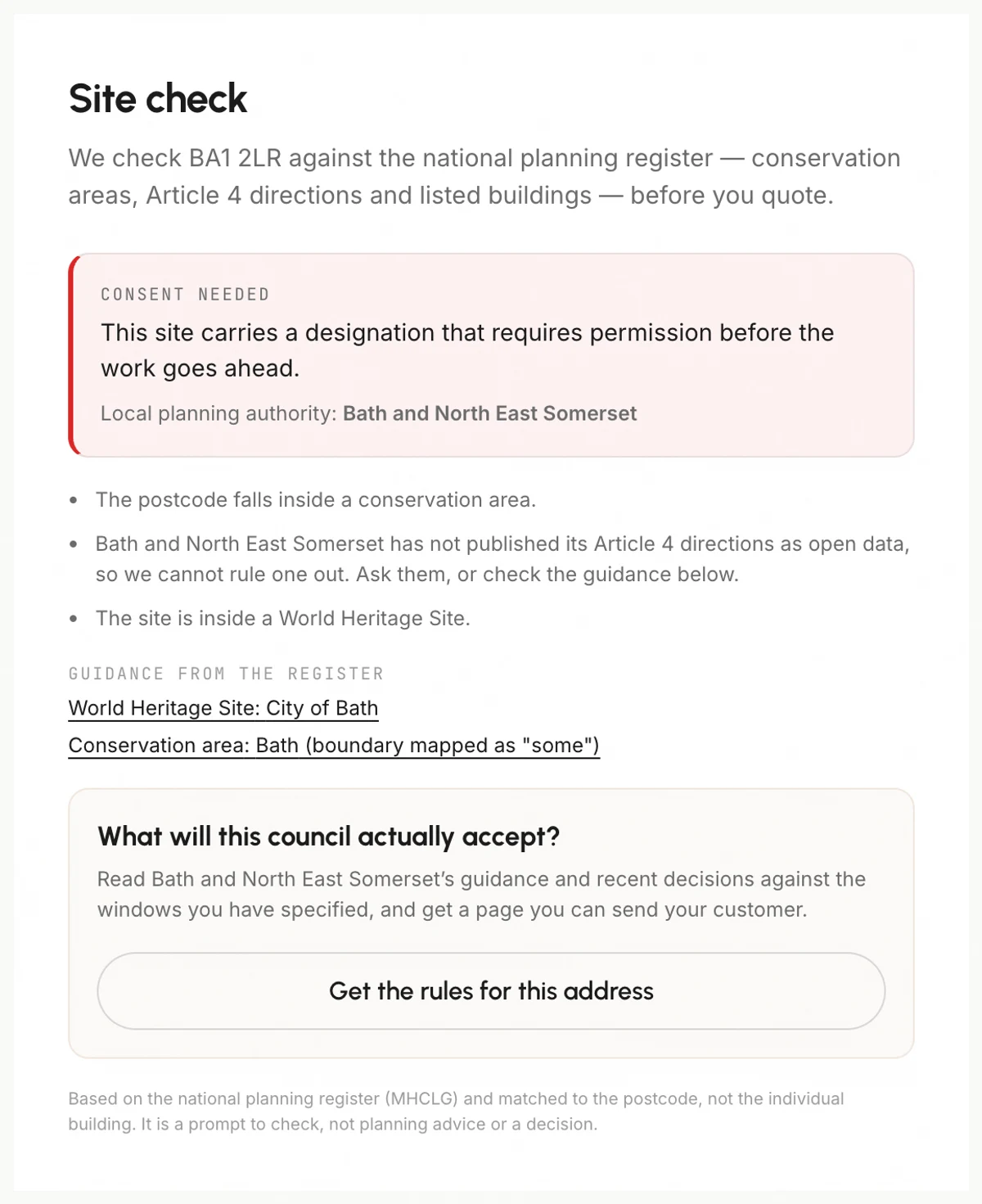
Three outcomes are possible, and the middle one is the most common and the most honest: nothing found; something found or the data cannot confirm; or a designation that definitely requires consent. Any tool that only offers a yes and a no is hiding the second case from you.
Turn the answer into something the customer can read
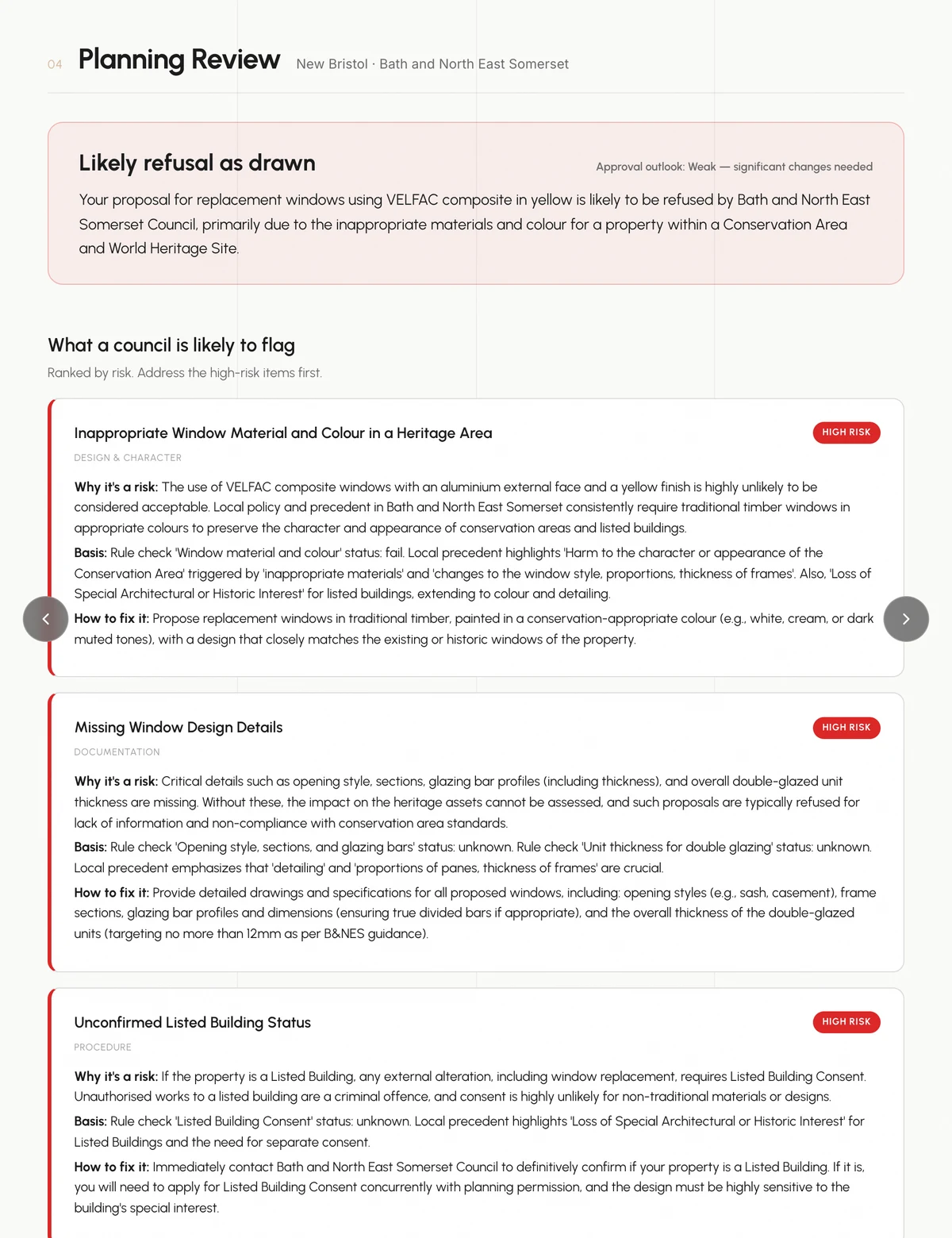
The commercial value is not only in avoiding an enforcement notice. It is in being the installer who can explain, on the doorstep, why the quote specifies timber rather than uPVC — with the council’s own guidance attached. That conversation is much easier to have when the reasoning arrives beside the price rather than in a separate email.
The short version
- A conservation area on its own usually does not stop window replacement — check before you turn work away.
- The Class A "similar appearance" condition is what most often takes a job outside permitted development.
- An Article 4 direction is what actually removes the right, and it applies even to like-for-like replacement.
- Listed buildings always need listed building consent, and unauthorised work is a criminal offence.
- For most councils you cannot prove there is no Article 4 — so ask, and price the answer in.
Check an address in seconds: Unformed for window installers checks every job against the national planning register between the address and the render, and the Planning Review add-on tells you what your council expects for the windows you have actually specified.
This guide is general information, not legal or planning advice. Planning rules change over time and are applied differently by each local planning authority (LPA). Always confirm the position with your council before starting work. Unformed’s Planning Review gives an AI-assisted risk assessment of a scheme but does not guarantee any planning outcome.